On a residential street in Polanco, hospitality has entered a building that was never meant to feel like a conventional hotel. Kimpton El Castelar opened on July 6, 2026 inside the Roel Building, a 1940 apartment house designed by Mexican architect Francisco J. Serrano.
The property contains only 34 rooms. That scale allows circulation, terraces and domestic proportions to remain part of the experience instead of being erased by a large central lobby. Guests encounter the building as a sequence of rooms adapted from urban living rather than as a standardized stack of accommodations.
At a glance
- Subject
- Hospitality
- Editorial series
- Special Story
- Story format
- Feature / Special Story
- Published
- July 6, 2026
- Reading time
- 7 min read
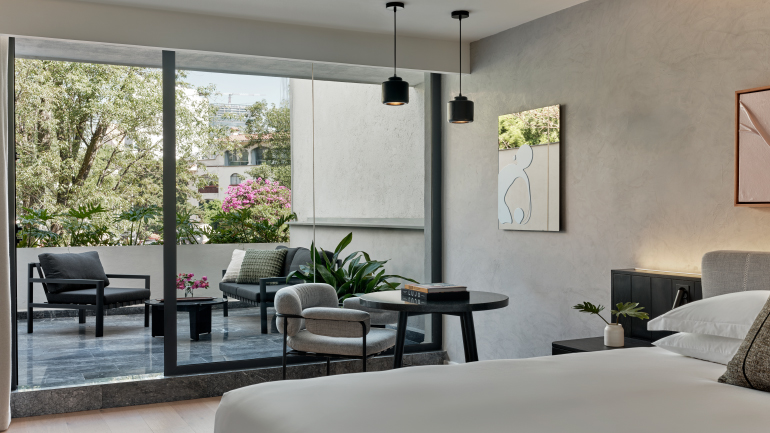
The design draws from the structure’s Mexican Art Nouveau inheritance without reconstructing 1940 as a theme. Faded terracotta, warm metals, natural stone, textured timber floors and cement tiles refer to local ceramic traditions, while bespoke furniture and artworks were sourced within Mexico.
Many rooms include soaking tubs, and private terraces extend the interior toward the street and sky. A rooftop plunge pool adds a more explicitly hotel-like amenity, but the building’s character depends on quieter evidence: wall thickness, window rhythm and the intimacy of the former apartments.
El Castelar joins Kimpton Virgilio nearby, another preserved apartment building. Together they suggest a model in which hotel growth does not require a single large footprint. A dispersed collection can retain smaller structures while allowing each address to develop a distinct relationship with its neighbourhood.
The design draws from the structure’s Mexican Art Nouveau inheritance without reconstructing 1940 as a theme.
Adaptive reuse in hospitality always carries a risk. Historic fabric can become a marketable backdrop while the actual social history of a building disappears. The more responsible approach is to let existing constraints shape the programme: fewer rooms, idiosyncratic plans and the acceptance that not every experience should be identical.
What El Castelar offers is less the novelty of sleeping in an old building than the continuity of inhabiting one. The project treats preservation as an operating condition, not a decorative layer. Its luxury comes from specificity—the feeling that this hotel could not have been produced in quite the same way anywhere else.
Context changes what an image can tell us. Long-form reporting connects a finished work to the systems, histories and decisions that made it possible.