Opening preview · Public opening announced for September 22, 2026 · Source-based architectural analysis
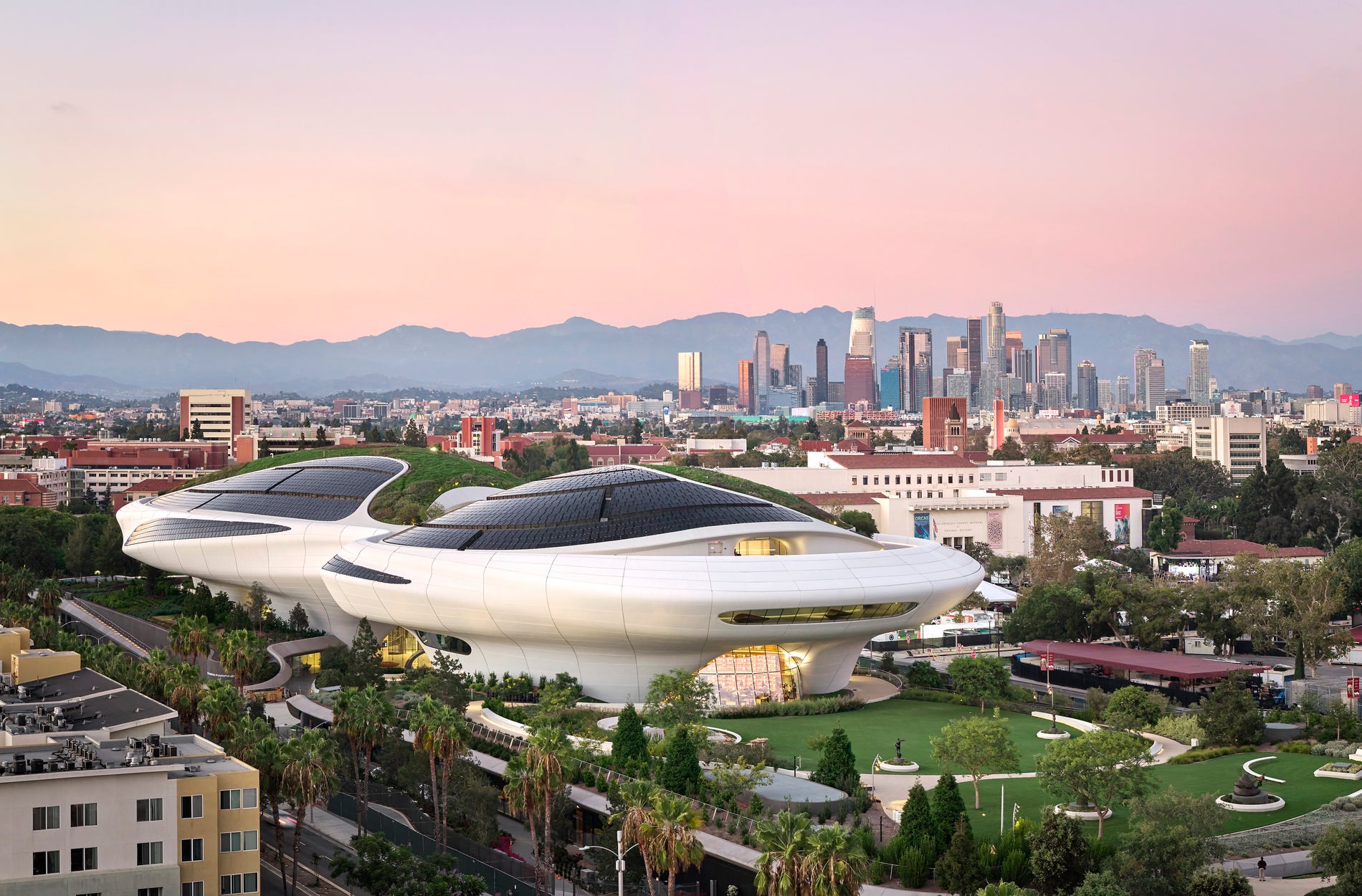
The most consequential view of the Lucas Museum of Narrative Art may not be the one in which its pale, airborne body fills the frame. It may be the view at ground level, where a former asphalt parking lot in Exposition Park has become a public landscape of trees, meadow, shade and movement. The museum opens to the public on September 22, 2026, but the civic proposition begins before a ticket is scanned.
Founded by George Lucas and Mellody Hobson, the institution occupies a 300,000-square-foot building designed by Ma Yansong of MAD with Stantec. More than 100,000 square feet of galleries will place illustration, comics, cinema, murals, painting and photography inside one account of narrative art. That breadth is important; so is the decision to make the museum part of a 13-acre campus rather than a self-contained object.
At a glance
- Subject
- Architecture
- Editorial series
- Special Story
- Story format
- Feature / Special Story
- Published
- September 4, 2026
- Reading time
- 7 min read
Ma’s building has no straight exterior line. It rises over a sheltered central plaza, touches the park at limited points and spans 185 feet at its central arch. More than 1,200 individually shaped fiberglass-reinforced polymer panels make the continuous skin possible. The formal language is emphatic, but its most useful effect is spatial: the mass is lifted so public life can pass underneath it.
The surrounding park and gardens, designed by Mia Lehrer and Studio-MLA, transform the approach into a sequence. More than 300 new trees join drought-tolerant and regionally adapted planting, a hanging garden, meadow, amphitheater and waterfall fountain. The contoured ground borrows from California’s foothills, valleys, mesas and canyons, turning arrival into an unfolding landscape rather than a direct march to the door.
This is not neutral scenery. The museum describes narrative art as a force that produces belief and community, and the landscape operates in the same way: it edits what visitors notice and when. A path can delay the building, frame a sculpture, open a view or create a place to gather without entering. Ten outdoor works extend the collection into a park that remains free and publicly accessible.
Ma’s building has no straight exterior line.
The environmental value of replacing asphalt is equally tangible. Tree canopy and planting can reduce heat, hold moisture and make habitat where a sealed surface previously intensified exposure. Those benefits will develop over time rather than arrive complete on opening day. The young park should be judged by shade, survival, maintenance and public use as its trees mature—not only by the first season of photographs.
Inside, the museum’s democratic claim will meet a curatorial test. Its inaugural exhibitions place popular forms beside conventional fine-art categories and include more than 1,300 works across over 30 galleries. That can widen the definition of what belongs in a museum, but equal standing depends on interpretation: whose stories are contextualized, whose power is examined and whose audiences feel addressed.
The free research library strengthens that argument. Holdings range from illustration, cinema and folklore to children’s literature, underground comics and the Lucasfilm research archive. By making research visible beside spectacle, the institution can show that world-building is not a flash of inspiration but an accumulation of references, technologies, labor and cultural inheritance.
The project’s image will inevitably invite debate. Its engineered curves can appear futuristic, cinematic or detached from the masonry institutions around Exposition Park. The stronger question is what the shape enables: shade beneath the building, circulation across the site and a continuous exchange between galleries and garden. Iconic form earns its place when it produces civic capacity, not when it simply announces itself.
Los Angeles did not need another object surrounded by parking. The Lucas Museum matters because its most ambitious move is a transfer of ground—from cars to people, from impermeable surface to living system, from a threshold controlled by admission to a park that can belong to the neighborhood every day. The architecture tells one story; the reclaimed landscape may tell the longer one.