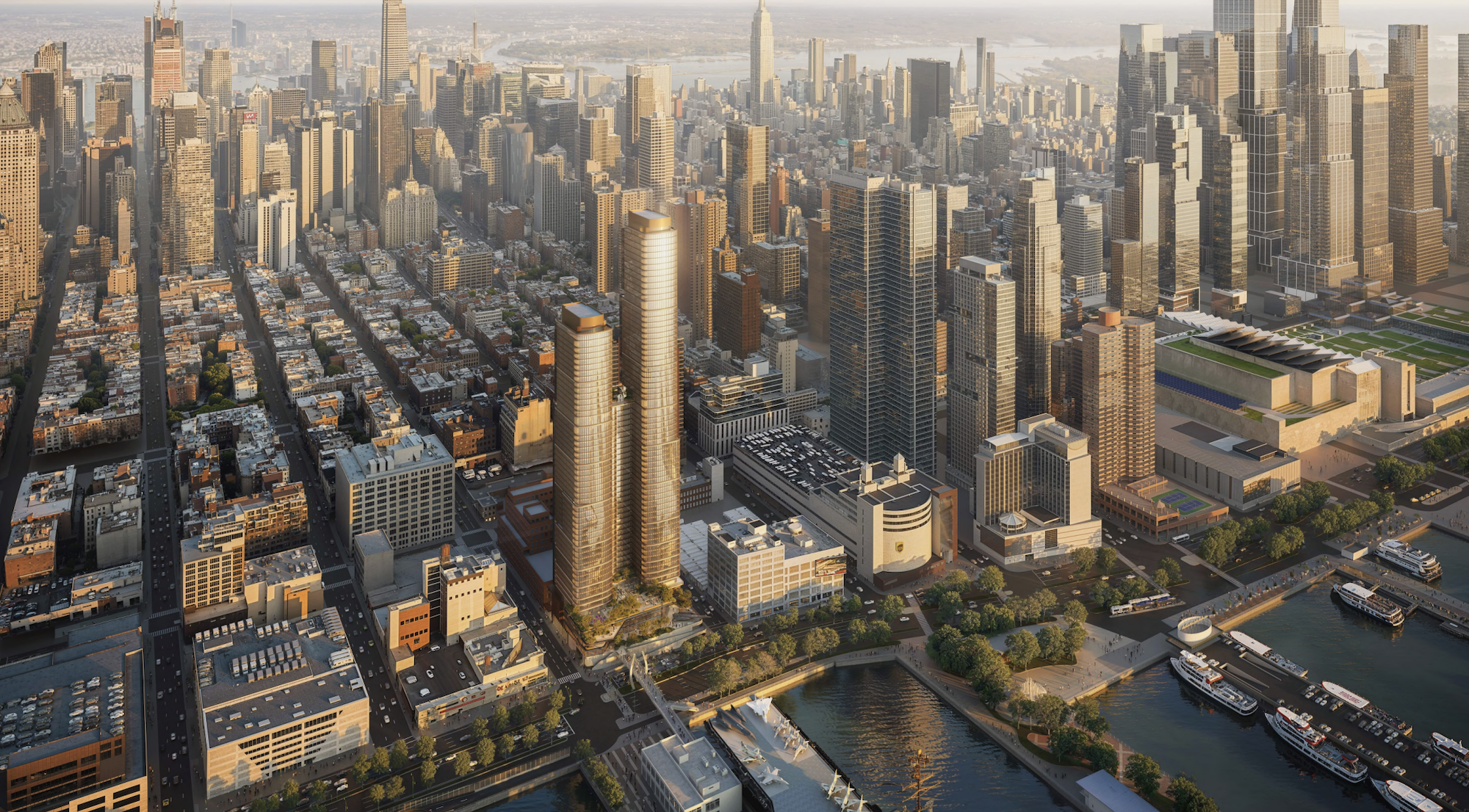
For years, one of the largest undeveloped parcels on Manhattan’s far West Side performed a narrow task. The state-owned site at 621 West 45th Street held surface parking for buses serving the Intrepid Museum. On July 15, 2026, New York selected a proposal to make the land carry much more.
The plan by Gotham Organization, Fisher Brothers and MURAL Real Estate Group calls for 1,127 homes in two connected towers designed by FXCollaborative. Up to 338 units—30 percent of the total—would be permanently affordable to households earning between 40 and 130 percent of area median income.
At a glance
- Subject
- Real Estate
- Editorial series
- Special Story
- Story format
- Feature / Special Story
- Published
- July 15, 2026
- Reading time
- 7 min read
The housing mix includes middle-income apartments intended for workers such as teachers, nurses and first responders. A for-sale component proposes 108 condominiums, 28 of them income-restricted. Those figures matter because affordability is distributed across rental and ownership rather than confined to one tenure.
The project also extends the Intrepid Museum across the West Side Highway. A roughly 22,000-square-foot Intrepid Concourse would contain a visitor center, STEM education hub and café. A new 9,800-square-foot park connects to the museum’s existing sky bridge and adds publicly accessible landscape with Hudson River views.
Density is being asked to subsidize several kinds of public value at once: housing, education, open space, remediation and replacement parking phased to keep museum operations functioning. That combination is precisely why public land deserves a more demanding development brief than a private parcel.
The housing mix includes middle-income apartments intended for workers such as teachers, nurses and first responders.
The site also carries environmental debt from its history as part of a manufactured gas plant. The development team has committed to remediation through New York’s Brownfield Cleanup Program. Before new architecture can claim sustainability, the ground itself must be made safe.
The announcement is a selection, not a completed building, and no construction timeline has been released. Its real success will depend on approvals, financing, delivery and the durability of promised affordability. Still, the proposal establishes a clear measure of opportunity cost: in a housing crisis, a well-located public parking lot is never only empty space.
Context changes what an image can tell us. Long-form reporting connects a finished work to the systems, histories and decisions that made it possible.