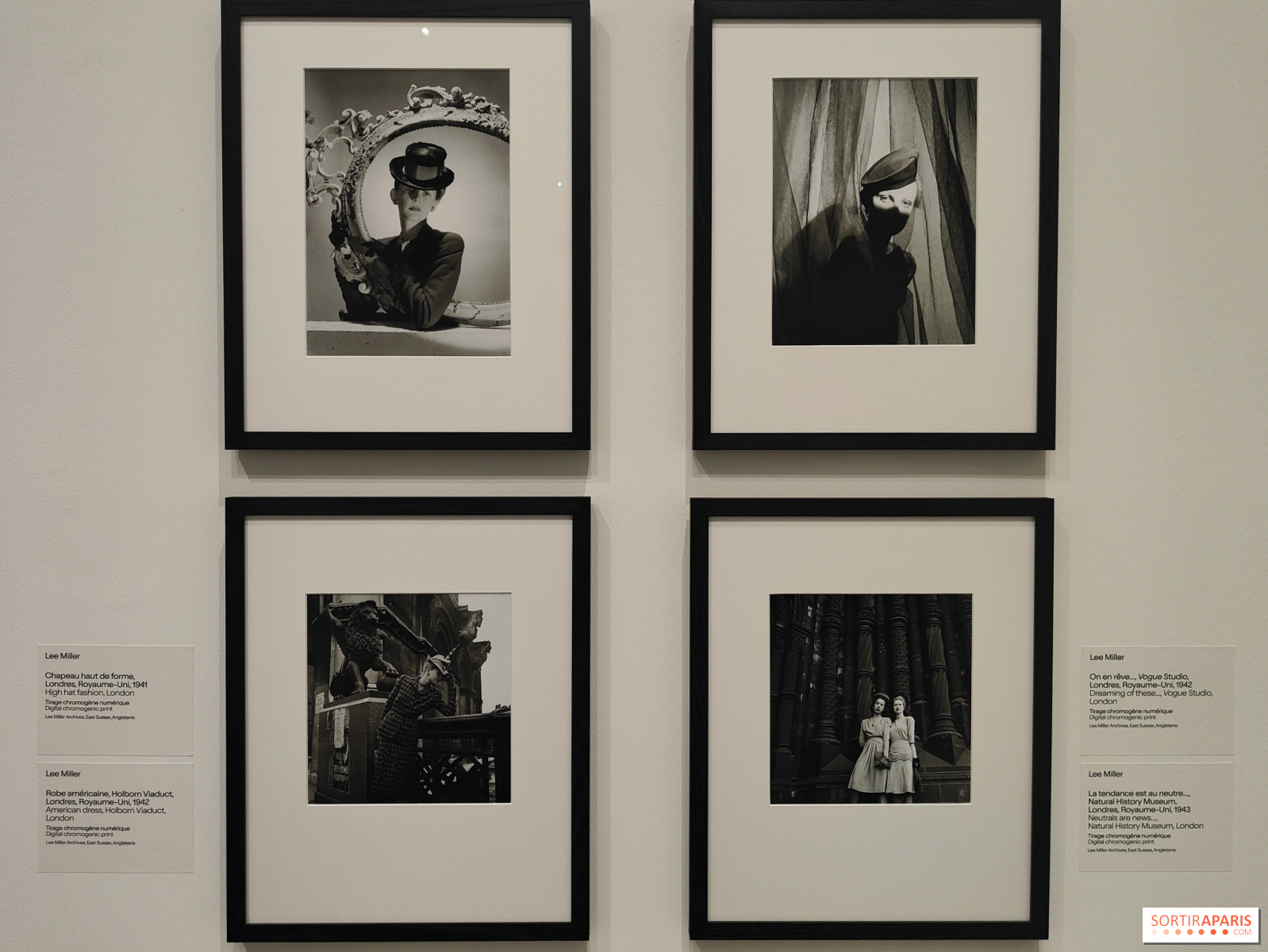
The first room of a Lee Miller retrospective presents a familiar problem. Before visitors meet the photographs she made, they encounter photographs made of her. In late-1920s New York and Paris, Miller was one of the most sought-after fashion models of her generation. Her face circulated widely; her authorship did not.
Lee Miller, presented by the Musée d’Art Moderne de Paris from April 10 to August 2, 2026, was designed to reverse that order of recognition. Organized with Tate Britain and the Art Institute of Chicago, the exhibition gathered roughly 250 vintage and modern prints across six chronological and thematic sections. It was the largest French retrospective devoted to Miller in twenty years.
At a glance
- Exhibition
- Lee Miller
- Venue
- Musée d’Art Moderne de Paris
- Dates
- April 10–August 2, 2026
- Scope
- Approximately 250 vintage and modern prints
- Organized with
- Tate Britain and the Art Institute of Chicago
- Next venue
- Art Institute of Chicago · August 29–December 7, 2026
The scale matters because Miller’s career is often compressed into several dramatic episodes: her collaboration with Man Ray, her wartime reporting, and the photograph of her in Adolf Hitler’s bathtub. Those images are unforgettable, but they can flatten a practice that moved continuously between fashion, portraiture, surrealism, landscape and documentary evidence.
Miller arrived in Paris in 1929 and entered the surrealist circle not only as a subject but as a collaborator and technician. Working with Man Ray, she helped develop the creative use of solarization, a process in which a negative or print is briefly exposed to light during development. The resulting reversal of tones produces luminous edges that make bodies and objects appear both physical and unreal.
The mythology of discovery has often credited Man Ray more comfortably than Miller. The retrospective instead places collaboration beside independence. Miller opened her own Paris studio, photographed for Vogue and exhibited alongside figures including Germaine Krull and Brassaï. Her oblique angles and unexpected juxtapositions reveal an eye already interested in how ordinary reality could be made psychologically unstable.
Before visitors meet the photographs she made, they encounter photographs made of her.
After returning to New York in 1932, she established another studio and received her first solo exhibition at Julien Levy Gallery. It would also be the only solo exhibition held during her lifetime. Two years later she moved to Cairo, where desert landscapes, architecture and fragments of material became subjects for tightly structured images. The photographs resist exotic spectacle; they depend on cropping, surface and spatial ambiguity.
When war began in Europe, Miller remained in London and worked increasingly for British Vogue. Fashion and devastation entered the same visual field. Clothing was photographed against the damaged city, while ruins became records of daily adaptation rather than distant symbols. Her ability to shift between assignments was not inconsistency. It was a method for noticing where public history entered private life.
In 1942, Miller became one of the few women photographers accredited as a war correspondent by the United States Army. She documented nurses, aviators and anti-aircraft personnel before following Allied troops across Europe after D-Day. Her reporting from Saint-Malo, Paris, Dachau and Buchenwald combined direct evidence with a deeply personal anger that distinguished it from more detached military photography.
The photographs made immediately after the liberation of the concentration camps carried a responsibility beyond composition. Published with her writing in Vogue, they helped make the machinery and human consequences of Nazi extermination visible to a broad public. The camera was no longer an instrument of fashion or surrealist disruption alone. It became a witness whose images had to be believed.
The retrospective demonstrates how easily a woman’s image can outlive recognition of her authorship. Restoring Miller’s full practice changes the history of surrealism, fashion photography and wartime reporting at the same time.
On April 30, 1945, after photographing Dachau, Miller and Life photographer David E. Scherman entered Hitler’s Munich apartment. Scherman photographed Miller in the bathtub, her dirty boots placed on the bathmat and a portrait of Hitler visible at the edge of the frame. The image was carefully staged, but staging did not make it less documentary. It condensed exhaustion, defiance, contamination and the collapse of power into one room.
After the war, Miller struggled with what she had seen. At Farley Farm House in Sussex, where she lived with Roland Penrose and their son Antony, photography gradually receded from professional life. The house became a meeting place for artists and writers, while cooking offered another field for experiment and unexpected combination. This quieter period is essential to the story because creative survival does not always resemble continuous production.
The Paris exhibition closed on August 2, but its argument continues when the survey travels to the Art Institute of Chicago from August 29. To restore Miller’s place in photographic history is not simply to move her name from muse to maker. It is to recognize how institutions, captions and repeated anecdotes decide whose authorship remains visible.
Miller’s career refuses the idea that a serious practice must stay within one genre. Fashion sharpened her understanding of construction. Surrealism taught her to distrust the obvious. Portraiture gave intimacy to public figures, while war reporting demanded moral clarity. The categories changed; the intelligence behind the frame did not.
Seen together, the photographs make a stronger claim than any single iconic image. Lee Miller was never waiting to be discovered inside somebody else’s story. She was already looking, choosing, composing and recording the world from her own position—and leaving behind an archive large enough to correct the frame.