A museum usually promises control: stable temperature, measured light, protected objects and a clear distance between artwork and visitor. Ancestral Futures, Tomás Saraceno’s exhibition at Haus der Kunst in Munich, begins by making that separation harder to sustain. Air moves sculptures, spiders build alongside people and the water consumed elsewhere becomes part of the story inside the galleries.
Opening on July 17, 2026 and continuing through February 7, 2027, the exhibition brings together two long-running communities initiated by Saraceno: Aerocene, which imagines movement powered by sun and air rather than fossil fuels, and Arachnophilia, a multispecies research network centered on spider webs. The works are presented as connected environments rather than autonomous objects.
At a glance
- Subject
- Art & Culture
- Editorial series
- Special Story
- Story format
- Feature / Special Story
- Published
- July 17, 2026
- Reading time
- 7 min read
The project’s most consequential collaboration was developed with eleven Indigenous communities of Red Atacama and Salinas Grandes in northern Argentina. That region sits above lithium reserves increasingly demanded by batteries and the energy transition. The exhibition connects extraction to fragile water cycles, asking what a supposedly green technology costs when viewed from the territory that supplies it.
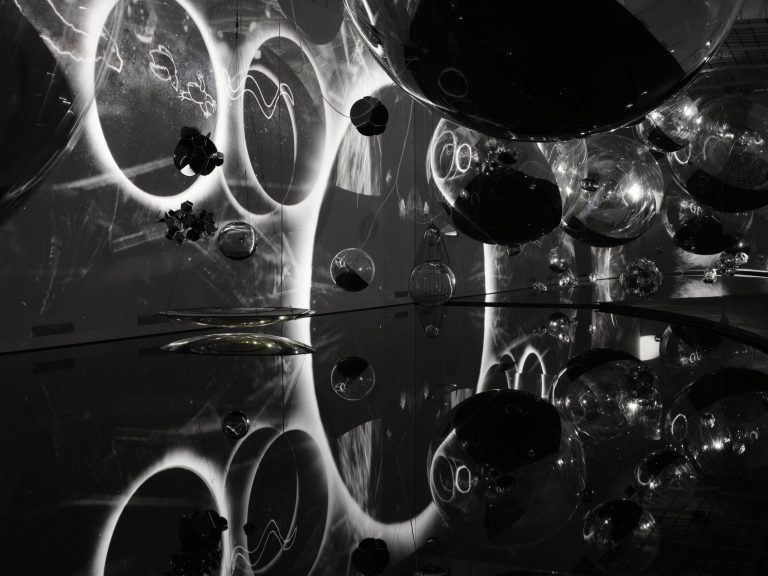
Saraceno’s spatial language makes those relationships perceptible without turning the gallery into a diagram. Suspended forms respond to currents of air. Webs register the labor of other species. Reflective and translucent surfaces shift the visitor from observer to moving condition. The room changes because a body has entered it.
Haus der Kunst extends the multispecies premise beyond metaphor. During the opening months, one gallery is accessible to dogs, with the institution treating canine perception as another way of encountering space. The gesture is modest but clarifying: inclusion can concern sensory worlds as well as human demographics.
The project’s most consequential collaboration was developed with eleven Indigenous communities of Red Atacama and Salinas Grandes in northern Argentina.
There is a productive tension in placing an argument about extraction and shared atmosphere inside a monumental museum. Large institutions consume energy and materials even as they host ecological critique. Ancestral Futures does not erase that contradiction. It uses the museum as a place where the infrastructures behind culture can become visible and discussable.
The exhibition’s strongest proposal is therefore not a single futuristic object. It is a change in authorship. Communities, animals, weather systems and materials are treated as active participants in the work. The museum becomes less a container for finished art than a temporary living system whose meaning depends on the relationships it can sustain.
Context changes what an image can tell us. Long-form reporting connects a finished work to the systems, histories and decisions that made it possible.