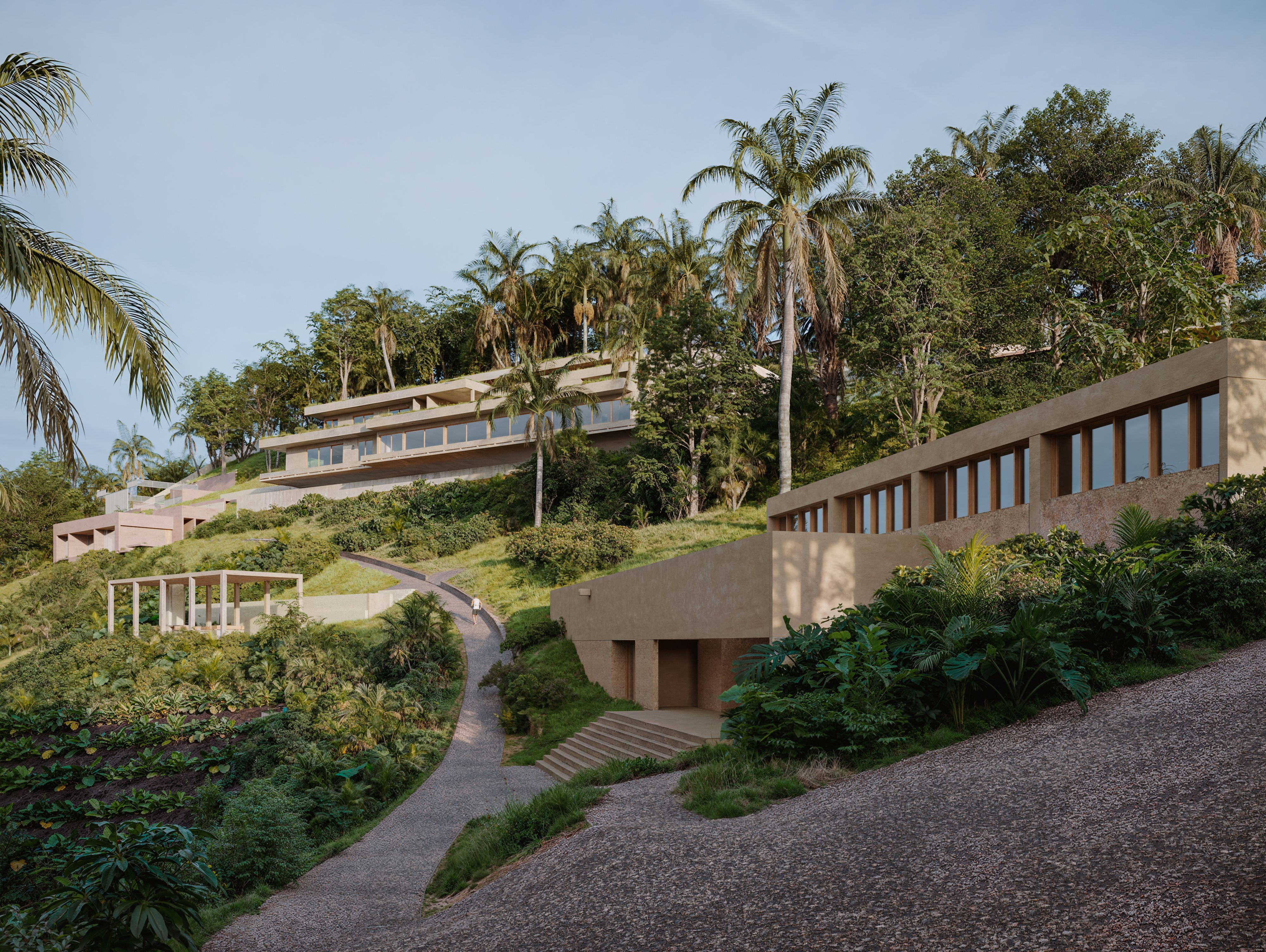
A seven-acre mountainside can tempt architecture toward spectacle. The view becomes the product and the building becomes the frame. At Aburi Residence & Retreat in Ghana, DeRoche Projects distributes the programme across six pavilions so that the forested ground remains an active part of the composition.
Wallpaper* included the Accra practice, established by Glenn DeRoche in 2022, in its 2026 Architects’ Directory. The studio’s growing portfolio moves across cultural, community and residential work, from Surf Ghana Collective to dot.ateliers Ogbojo and Backyard Community Club.
At a glance
- Subject
- Practice
- Editorial series
- The New Practice
- Story format
- Profile / Visit
- Published
- August 13, 2026
- Reading time
- 4 min read
At Aburi, residential spaces are joined by artist residencies, wellness areas, a private gallery, a contemplative pavilion, a paddle court, farm and supporting buildings. The programme is extensive, but separation allows paths, vegetation and changes in elevation to organize daily movement.
Deep recesses protect glazed facades and create a slower threshold between interior and landscape. Materials, craft and labor are sourced within Ghana where possible, making the project’s relationship to place economic and technical as well as visual.
The structural strategy includes concrete made with locally produced pozzolanic ash replacing a portion of conventional cement. That decision does not make concrete impact-free, but it addresses the material’s embodied carbon within the actual construction system rather than relying only on planted imagery.
At Aburi, residential spaces are joined by artist residencies, wellness areas, a private gallery, a contemplative pavilion, a paddle court, farm and supporting buildings.
DeRoche describes sustainability as embedded rather than added. Aburi gives that position a spatial form: smaller volumes respond to terrain, passive protection moderates climate and local production carries knowledge into the finished work.
The project’s ambition lies in treating the mountainside as a collaborator, not scenery. It asks the architecture to remain discontinuous enough for landscape, air and human movement to complete the experience—an approach that gives an emerging practice a clear ethical and formal direction.
Emerging practices show where creative culture is moving before the shift becomes a familiar style. These stories document the methods, responsibilities and new forms of authorship behind that change.