Nina Cooke John founded Studio Cooke John as a multidisciplinary architecture and design practice centered on placemaking. The studio’s work moves between domestic space, public art and the street while remaining focused on how people encounter one another through the built environment.
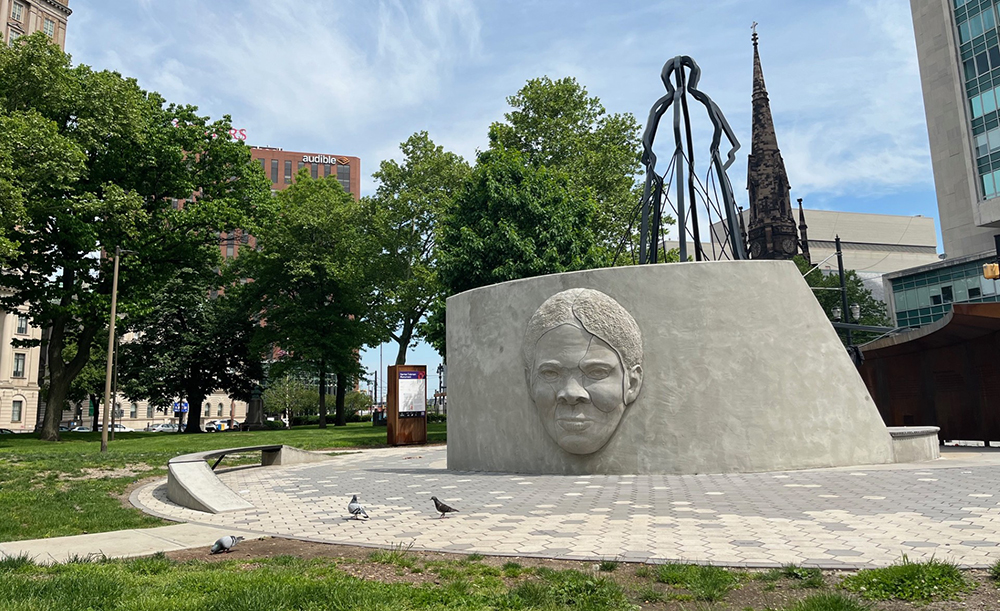
Shadow of a Face, the Harriet Tubman monument unveiled in Newark in 2023, is conceived as an inhabitable public experience rather than a distant object. Story, portraiture, materials and landscape invite visitors to move through history at human scale.
At a glance
- Subject
- Architecture
- Editorial series
- The New Practice
- Story format
- Profile / Visit
- Published
- August 1, 2026
- Reading time
- 4 min read
The project demonstrates how a monument can hold authority without closing interpretation. Memory becomes spatial, participatory and connected to the everyday life of the city around it.
Traditional monuments often establish distance through height and a single authoritative image. Shadow of a Face instead uses movement and multiple forms of representation to create a relationship between visitor, Tubman’s legacy and the present city.
The studio’s attention to the human body links public work to residential architecture. Scale, touch, threshold and route determine whether a place feels available to people or merely visible from a distance.
The project demonstrates how a monument can hold authority without closing interpretation.
The Newark monument combines portraiture, text, sound and landscape rather than relying on a single heroic figure. That plurality allows the work to communicate across ages and levels of prior knowledge.
Material responsibility is part of the story as well. The project participated in research around fair labor in building supply chains, connecting the commemoration of freedom to the contemporary conditions through which public work is produced.
Cooke John demonstrates that civic meaning is strongest when it enters daily life. A monument can remain solemn while also functioning as a path, gathering place and recurring encounter for the community around it.
Emerging practices show where creative culture is moving before the shift becomes a familiar style. These stories document the methods, responsibilities and new forms of authorship behind that change.