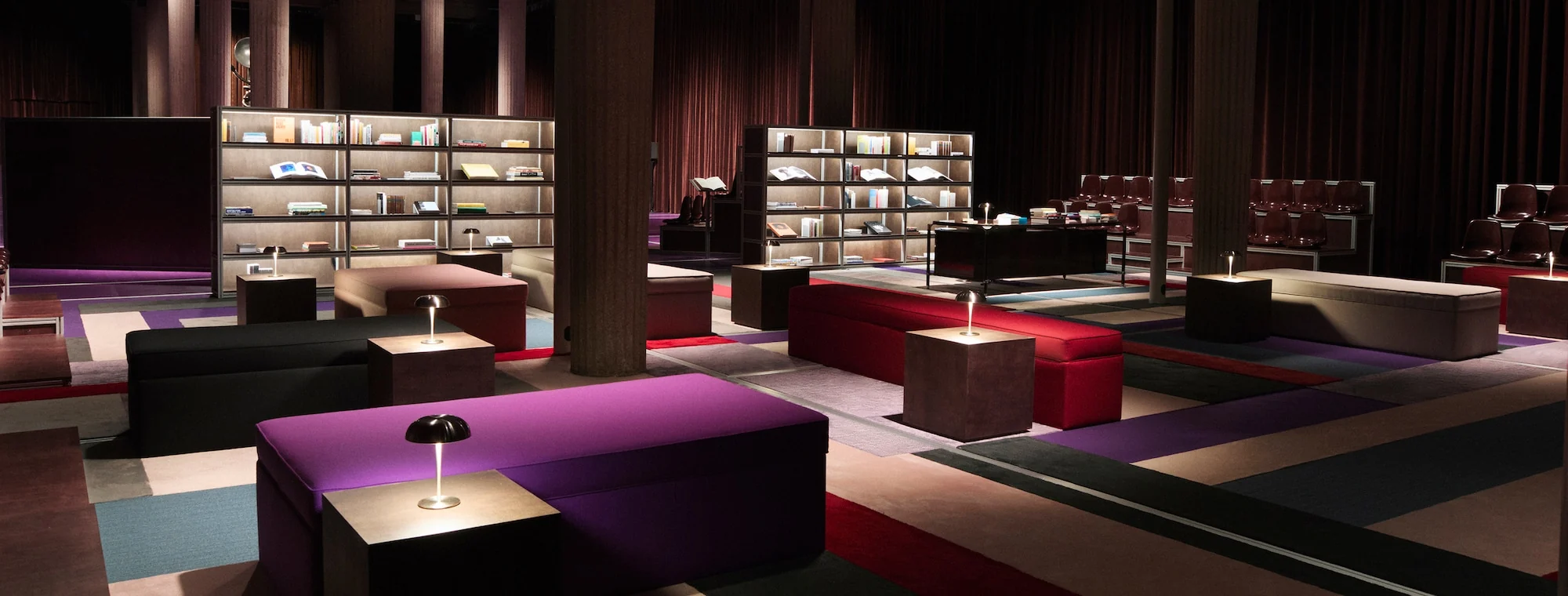
A library occupies an unexpected position within Geste de Consolation: it becomes a place to pause inside an exhibition assembled by a filmmaker. Presented by Miu Miu at the Palais d’Iéna from October 21 to 25, 2026, Alice Diop’s project places books and a domestic atmosphere within the building’s monumental concrete setting. The contrast gives reading a physical presence within the exhibition. 1
This is Diop’s first exhibition project. Art Basel describes a route through four connected spaces, with contributions across photography, cinema, literature, music, dance and sculpture. Its public programme provides the framework, while Diop’s selection brings together Black women whose work has informed her thinking. The sequence culminates in Simone Leigh’s bronze Sentinel (Mami Wata), dated 2020–21. 2
The project develops a question already present in Fragments for Venus, Diop’s 2025 film for Miu Miu Women’s Tales. That work follows a Black woman through a museum and another through Brooklyn, connecting historical representations with contemporary bodies and lives. It premiered at the Venice Film Festival’s Giornate degli Autori on August 30, 2025. The relationship matters here because the exhibition transfers a cinematic problem into a space where spectators determine the pace of their attention. 3
In Paris, a photograph by Zanele Muholi introduces the itinerary. Diop’s own installation uses two screens and archival material. The library, Chambre à soi, includes carpets bearing a motif by Mary Lee Bendolph; nearby, a performance area introduces another form of gathering. These components give the exhibition several durations: the time needed to register an image, read a passage or remain with a live performance. 1
The programme includes readings from writers such as Audre Lorde and Zora Neale Hurston, alongside contributions from choreographer Nadia Beugré and musician Angel Bat Dawid with Sistazz of the Nitty-Gritty. In the organisers’ account, movement between these disciplines works like montage. Meaning develops through adjacency and sequence, allowing an image encountered earlier to remain active while a different voice is heard. 2
The library gives the exhibition’s influences a place where they can be examined. Visitors can spend time with the texts behind Diop’s thinking before entering a space organised around live voices and shared attention. That shift makes the sequence of rooms central to the work. It changes the visitor’s activity from watching to reading and listening, while keeping earlier encounters in memory. Diop extends the filmmaker’s control of sequence into an exhibition whose pace belongs partly to the person moving through it.