APPARATUS brought Act V: Afsaneh to the ground floor of its Mayfair gallery during the district’s 12–16 October 2026 programme. The presentation at 7 Mount Street gave a spatial setting to a collection that extends from lighting to furniture, vessels and incense. Its organisation suggests a room developed through recurring ideas, with each object contributing to a larger atmosphere. 1, 2
The collection’s name supplies its emotional centre. In Gabriel Hendifar’s introduction, Afsaneh is both the Persian word for fable and his mother’s name. He describes drawing curves repeatedly, allowing forms to emerge, and developing the work around cycles of creation, separation and return. Those personal references establish the narrative through which the pieces are presented. 3
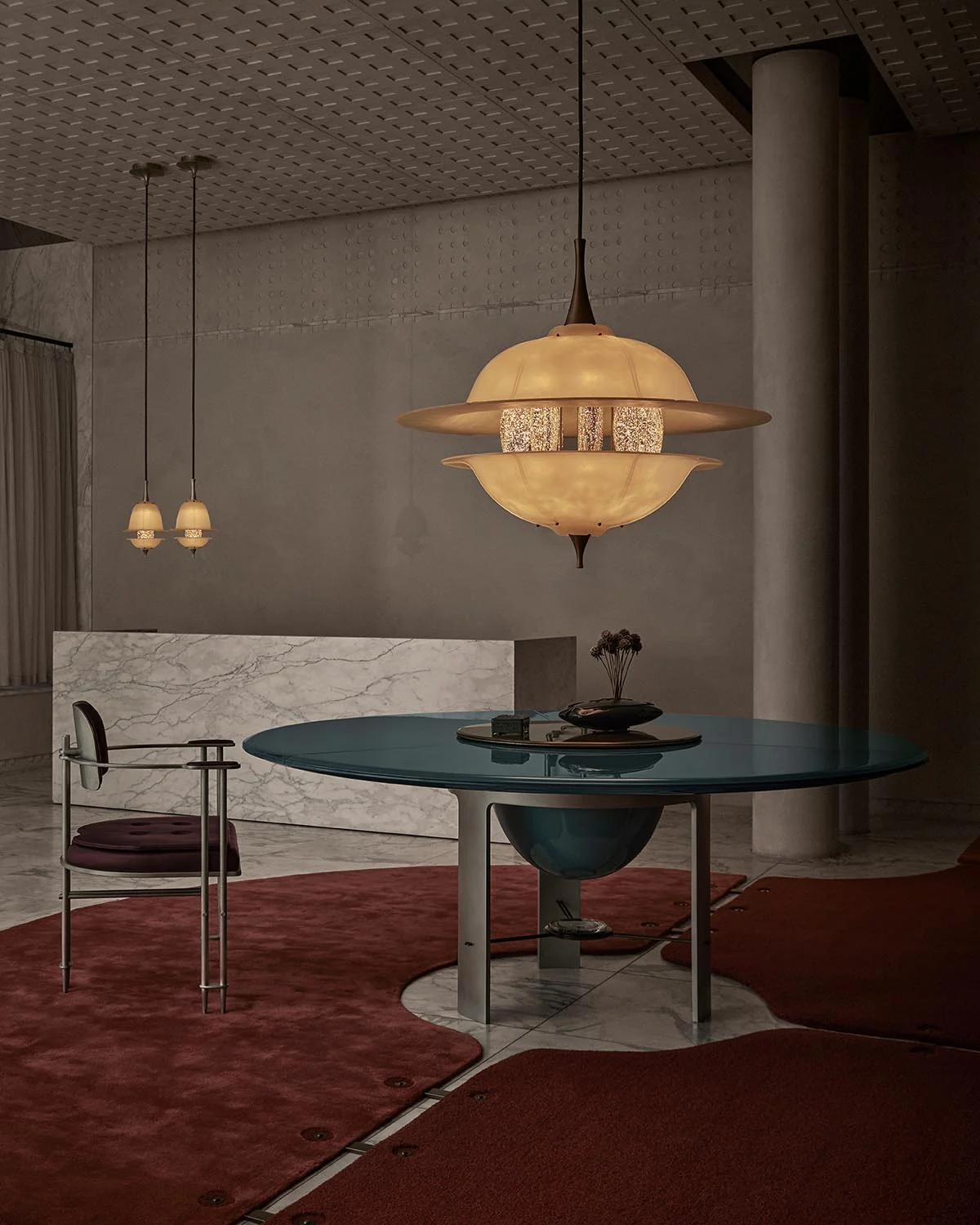
One of the clearest material expressions is GOL. The pendant combines fibreglass shades shaped as petals, a brass structure and a cast-glass central element. APPARATUS lists botanical structures among its references, alongside Fortuny and amplification technology. The result brings several ways of understanding form into one lighting family: growth, dress, projection and illumination. 4
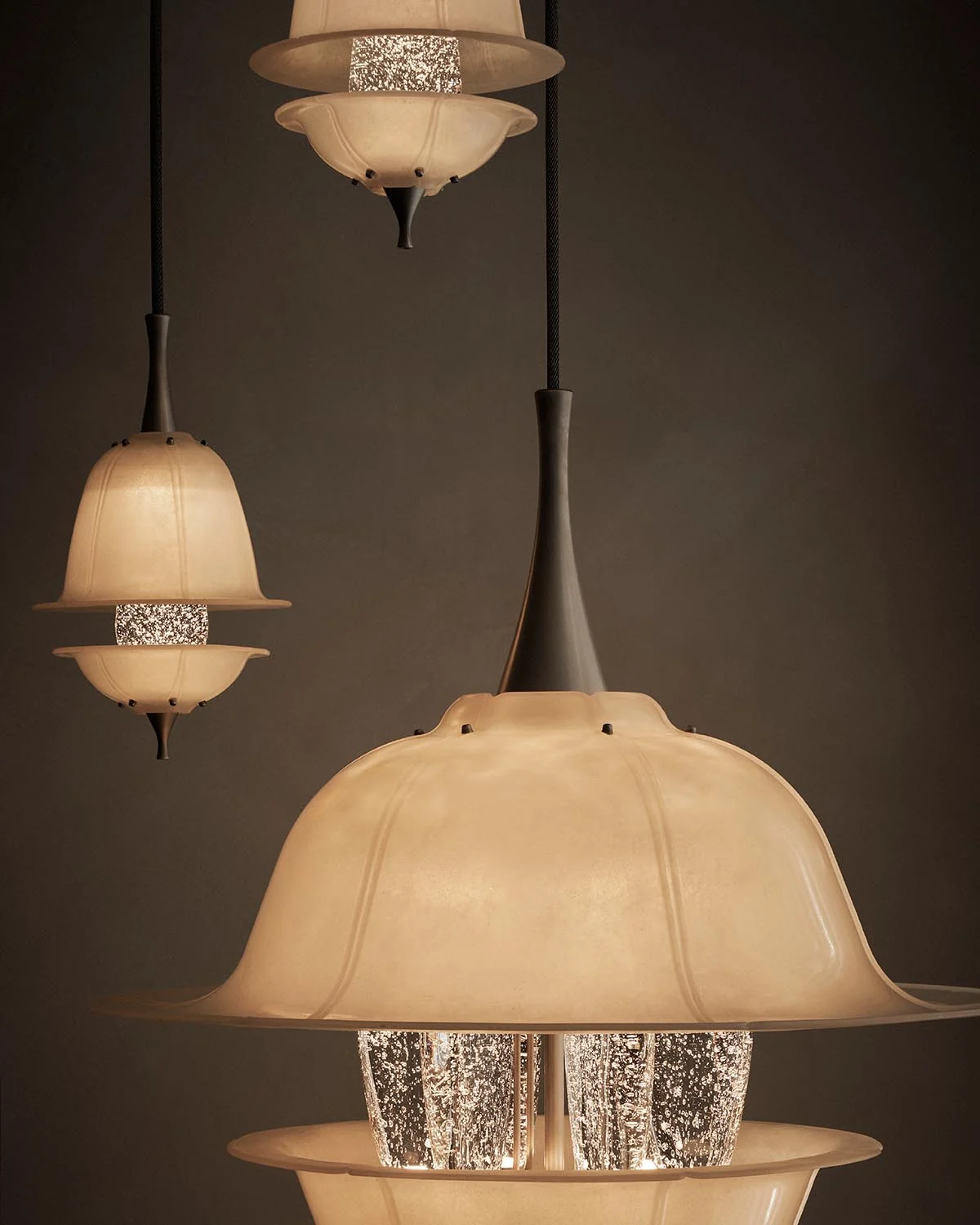
The combination is interesting at the scale of a room. A pendant occupies the air above everyday activity, where its proportions can organise the relationship between a table and the surrounding space. Here, the botanical reference gives that suspended object a recognisable logic. The analogy also invites closer attention to how individual parts gather around a centre.
Act V’s broader catalogue develops a vocabulary across several positions and uses. RAHVI appears as sconces, pendants, installations and a table lamp; JAHAAN includes dining and cocktail tables; AFSANEH takes the form of a divan. This range provides opportunities for related gestures to recur at different heights without requiring every object in a room to perform the same role. 2
Such repetition places a particular responsibility on composition. A strong family of forms needs intervals: an unoccupied surface, a quieter wall, sufficient distance for a silhouette to be understood. The collection’s theatrical character makes those ordinary spatial decisions especially consequential. Atmosphere depends on what is left between the pieces as much as on the objects selected.
Hendifar’s written account also connects the collection to Martha Graham’s language of movement and to an incense composition of Damask rose, oud and frankincense. These references widen the project beyond its visible forms, introducing time, bodily movement and scent as parts of its intended experience. 3
Afsaneh is most compelling as an invitation to examine how an interior holds a story. Its personal origin remains identifiable, while its parts address familiar acts of sitting, gathering and lighting a room. The London presentation places those acts within a shared vocabulary, giving the collection a framework that can be read from the scale of a vessel to the space around a group of people.