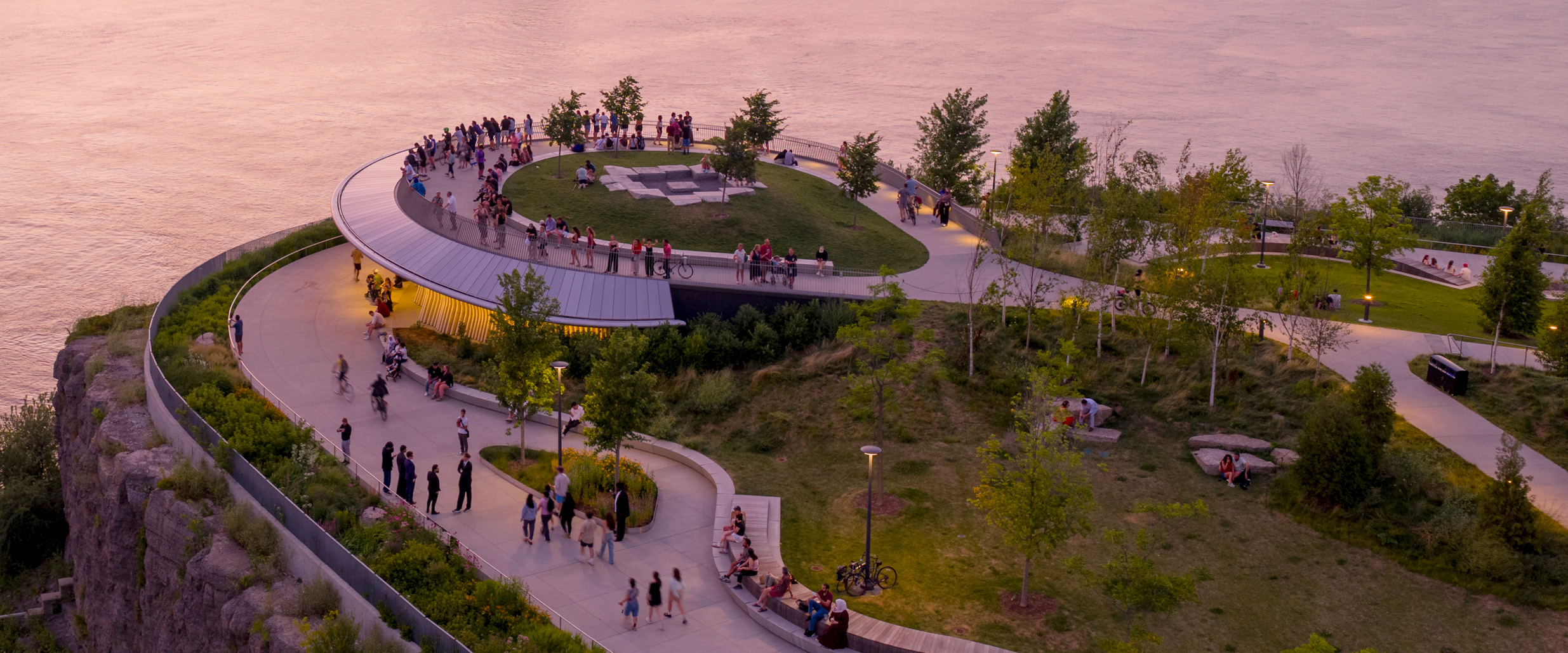
A national capital often organizes memory vertically. Statues rise above lawns; axes direct the eye; distance becomes authority. At Kìwekì Point in Ottawa, landscape architecture reverses that habit. The renewed promontory asks visitors to look outward and downward—toward the Kichi Zibi, the plants at the escarpment and the layered histories of the land beneath a national narrative.
Designed by Janet Rosenberg & Studio for the National Capital Commission, the project received the 2026 ASLA Award of Excellence in General Design. Its name, chosen through collaboration with the host Anishinaabe Algonquin Nation, means “to return to one’s homeland.” Naming is not treated as a plaque attached to a finished park; it is part of a wider reorientation of the place.
At a glance
- Subject
- Landscape
- Editorial series
- Material Intelligence
- Story format
- Profile / Visit
- Published
- September 3, 2026
- Reading time
- 4 min read
The former Nepean Point had been underused for more than two decades, with failing infrastructure, hazardous materials and a vehicle-dominated entrance. A monument to Samuel de Champlain controlled the lawn and the river view. The redesign does not remove history from the site. It changes the spatial hierarchy through which that history is encountered.
The Champlain monument now sits within a white-pine grove, while its granite plinth has been reused as seating. The Kichi Zibi Innini figure was moved to a location selected with the local Indigenous community. These acts turn relocation into interpretation: neither figure disappears, but neither is allowed to occupy the landscape as an unquestioned, singular account.
A new Pìdàban Bridge—its name means “dawn”—connects pedestrians and cyclists to Ottawa’s broader open-space network. At the edge, a cedar pavilion called Whispering Point offers shelter and directs attention toward the river. The project makes access and orientation carry meaning; movement through the park becomes a way of reading it.
The former Nepean Point had been underused for more than two decades, with failing infrastructure, hazardous materials and a vehicle-dominated entrance.
Planting supplies another register of memory. Nearly 9,000 native and adapted pollinator plants form a linear garden along the escarpment, joined by 150 new trees, 2,100 native perennials and 13,500 spring bulbs. Seven river-associated creatures selected with Algonquin communities appear within the planting and on trilingual panels illustrated by Algonquin artist John Tenasco.
The sensory emphasis is deliberate. Sound, scent, shade and seasonal change compete with the monument for attention. Tree placement draws on psithurism—the sound of wind moving through leaves—while the meadows require little irrigation and a single annual cut. Ecological performance is not hidden behind a technical report; it becomes part of how the park feels.
Collaboration is visible in the authorship. Algonquins of Pikwakanagan and Kitigan Zibi Anishinabeg informed the interpretive framework, naming and monument decisions. Patkau Architects designed the pavilion and bridge, with heritage, engineering, lighting and horticultural teams contributing to a project that could not be resolved by a single discipline.
The park does not promise that a changed setting can repair colonial history. That would place too much moral weight on form. What landscape can do is interrupt the old certainty: offer multiple stories, redistribute attention and create space for people to gather in relation to land and water rather than beneath one commanding figure.
Materials are never neutral. Their sourcing, behavior, fabrication and aging shape both the experience of an object and the values it carries.
Kìwekì Point demonstrates that the opposite of erasure is not stasis. Public memory can be made more truthful by changing position, scale and context. The monument remains, but the river has regained the horizon. The landscape now asks every visitor to understand return as an active relationship—to place, to story and to who has the authority to name both.