A city-wide design festival is less like an exhibition than a temporary operating system. It changes where attention goes, which institutions speak to one another and how visitors connect a light installation in a cathedral to a material experiment in a studio district. London Design Festival returns from September 12 to 20, 2026 with that distributed form as its central strength.
The 24th edition combines Landmark Installations, Special Projects, a Partner Programme, design districts and the Global Design Forum. No single venue can contain its argument. The festival is assembled through routes, encounters and the contrast between historic institutions, commercial showrooms, universities and independent spaces.
At a glance
- Subject
- Art & Culture
- Editorial series
- Field Notes
- Story format
- Brief
- Published
- September 2, 2026
- Reading time
- 3 min read
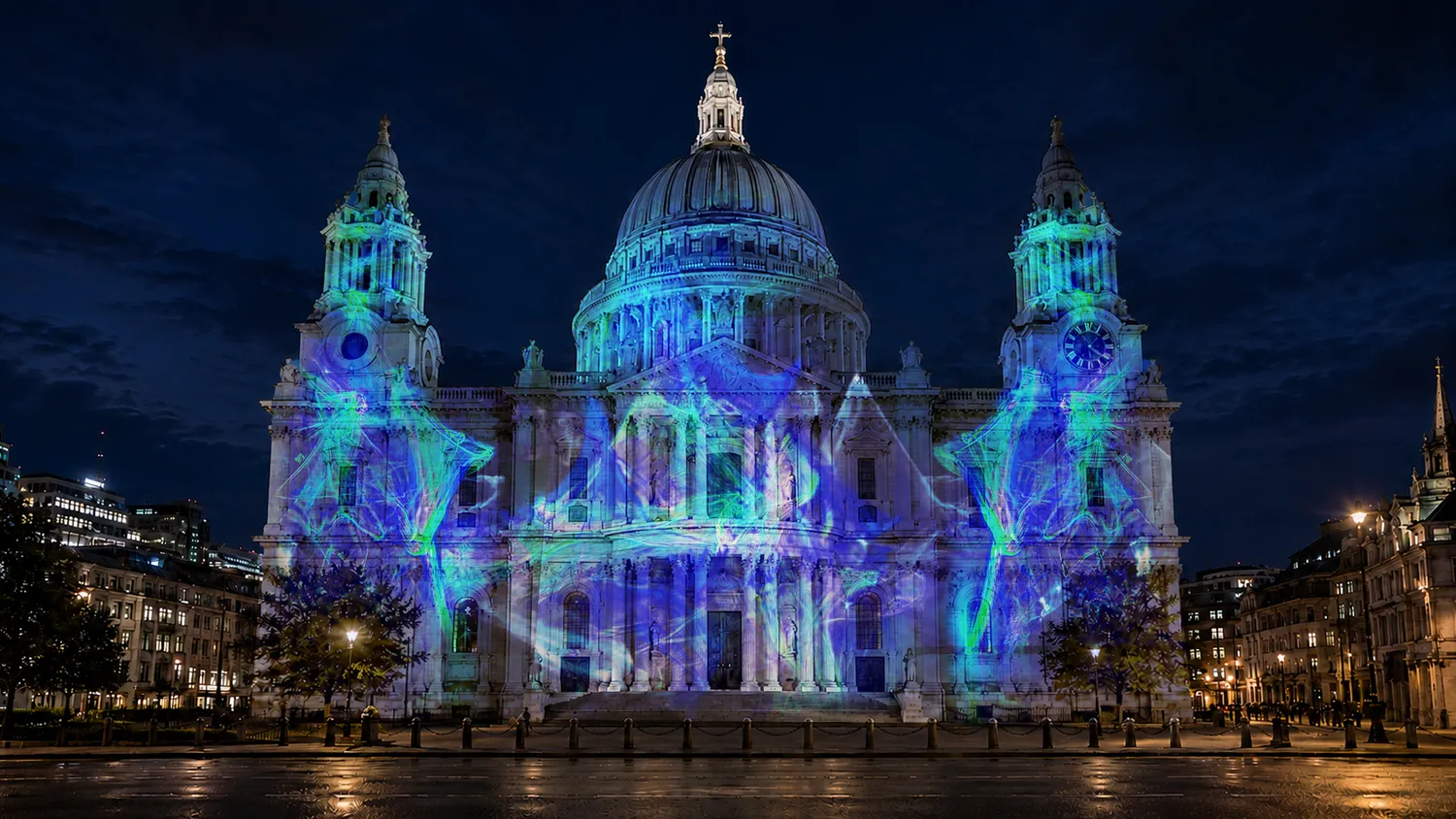
At St Paul’s Cathedral, Ukrainian lighting designer and artist Mykola Kabluka presents Soul and The Point of Unity, produced by Expolight. One work reaches the exterior through projection; the other creates an immersive light sculpture inside. Their placement brings contemporary media into dialogue with an architecture built for worship, ceremony and collective memory.
The works do not depict Russia’s war against Ukraine directly, but the festival describes them through questions shaped by rupture: how inner light is preserved, how hope becomes action and how connection can provide strength. In a cathedral, those themes carry both spiritual resonance and the political specificity of the artist’s context.
Elsewhere, the program brings global exchange, revived craft and future-facing technology into proximity. The most useful projects will resist presenting those ideas as opposites. Digital tools can transmit heritage or flatten it; craft can sustain living knowledge or become a nostalgic surface. Design matters in how the relationship is structured.
At St Paul’s Cathedral, Ukrainian lighting designer and artist Mykola Kabluka presents Soul and The Point of Unity, produced by Expolight.
The Global Design Forum, held at the Victoria and Albert Museum from September 12 to 14, gives discourse a defined place within the visual abundance. Talks and debates can slow the festival down, asking what new objects and installations claim to solve, who participates in their production and which consequences remain outside the display.
Design districts perform another kind of editorial work. By grouping nearby studios and venues, they turn geography into a reading sequence and allow smaller practices to benefit from shared attention. The addition of new districts changes the cultural map without pretending every part of London receives equal visibility.
That inequality is part of the format’s challenge. A city-sized program rewards mobility, time and familiarity. Digital guides and curated routes can reduce friction, but access is also shaped by transport, opening hours and whether events feel genuinely public. The festival’s civic claim depends on more than the number of pins on a map.
The best way to read LDF is therefore not as a list to complete. It is a chance to compare contexts. The same material may behave differently in a trade display and a museum; the same designer may speak through a finished object and an unfinished research process. The distance between venues becomes part of the interpretation.
Temporary events often reveal larger changes in how art, design and public space are being produced and experienced. Recording them gives a short-lived moment a longer context.
For nine days, London becomes an exhibition whose walls are already occupied by ordinary life. That condition prevents design from appearing fully controlled. Traffic, weather, worship, retail and neighborhood rhythms continue around it. The festival succeeds when the city does more than host the work—when it changes what the work is able to mean.


