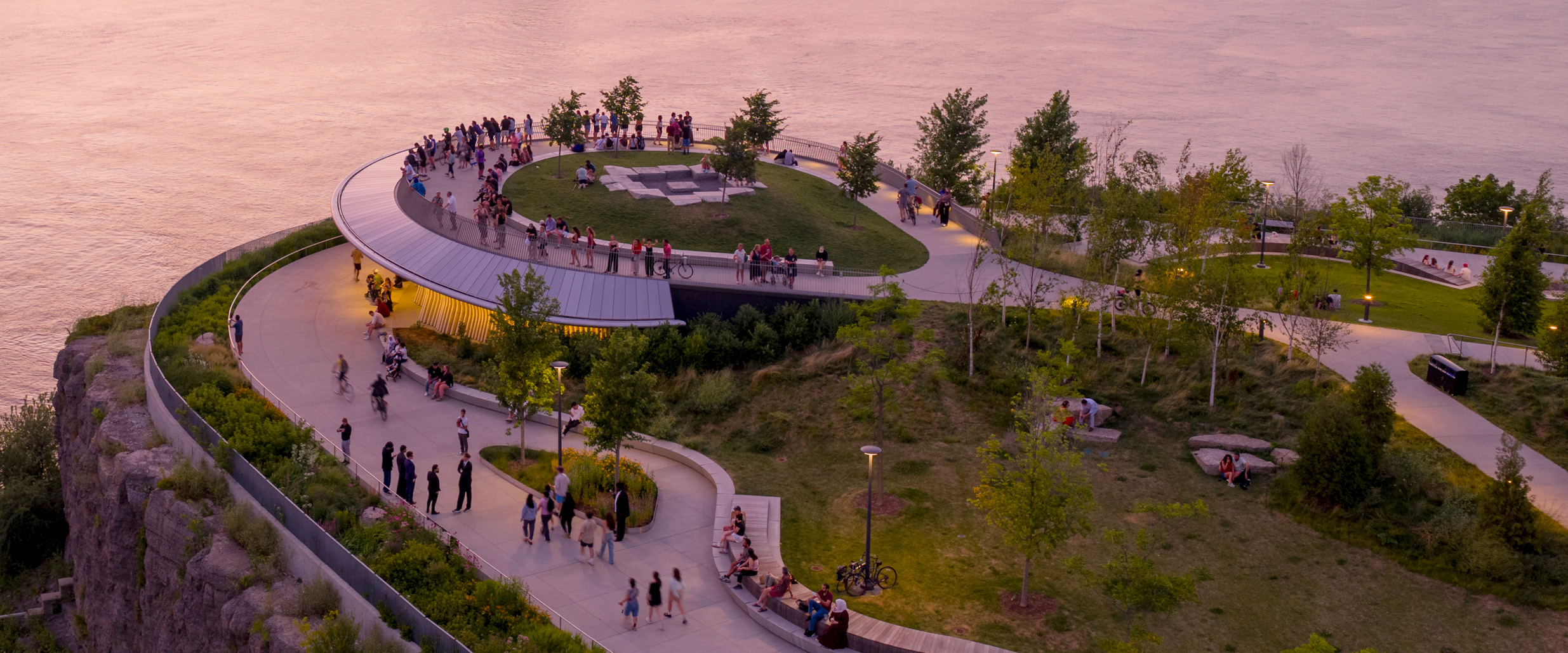
Piet Oudolf began his landscape and garden design practice with Anja Libbenga in 1976. In 1982 they moved to Hummelo, where they established a nursery focused on unusual but garden-worthy perennials.
His official project archive includes the High Line in New York, Lurie Garden in Chicago, The Battery, Hauser & Wirth Somerset and numerous public gardens across Europe, Asia and the United States.
At a glance
- Subject
- Landscape
- Editorial series
- Material Intelligence
- Story format
- Profile / Visit
- Published
- July 4, 2026
- Reading time
- 4 min read
Oudolf’s influence lies in treating planting as a composition through time. Seed heads, winter structure and decline are not failures of the garden; they are part of its designed life.
Many designed landscapes are judged at the moment of completion, when every edge is controlled and every plant appears to occupy its assigned place. Oudolf’s work asks for a different kind of attention. The composition unfolds through growth, flowering, decline and winter structure. A garden is not a static picture but a sequence of conditions. The designer therefore works with time as deliberately as an architect works with space.
This changes the meaning of maintenance. Cutting everything back at the first sign of decay may produce neatness, but it can also erase texture, habitat and seasonal drama. Seed heads catch light; dry stems establish rhythm; faded color reveals the structure of a planting community. Oudolf’s approach does not romanticize neglect. It depends on deep horticultural knowledge and precise selection. The apparently natural effect is held together by decisions about form, longevity, compatibility and succession.
Oudolf’s influence lies in treating planting as a composition through time.
In public projects, this temporal intelligence can create repeated discovery. A visitor who returns to the High Line or Lurie Garden does not encounter the same visual field each month. Familiar paths are reorganized by height, density, movement and color. The landscape rewards return rather than exhausting itself in a single spectacular view. That quality is especially valuable in cities, where daily routines can make public space invisible. Change restores attention.
For designers in any discipline, the broader lesson concerns control. A mature project may need to accommodate transformation without losing identity. Materials weather, people adapt spaces and brands enter new contexts. The answer is not to prevent change but to design the principles that guide it. Oudolf’s gardens remain recognizable because their underlying relationships are strong enough to absorb seasonal difference. Durability is produced through change, not through resistance to it.
Materials are never neutral. Their sourcing, behavior, fabrication and aging shape both the experience of an object and the values it carries.