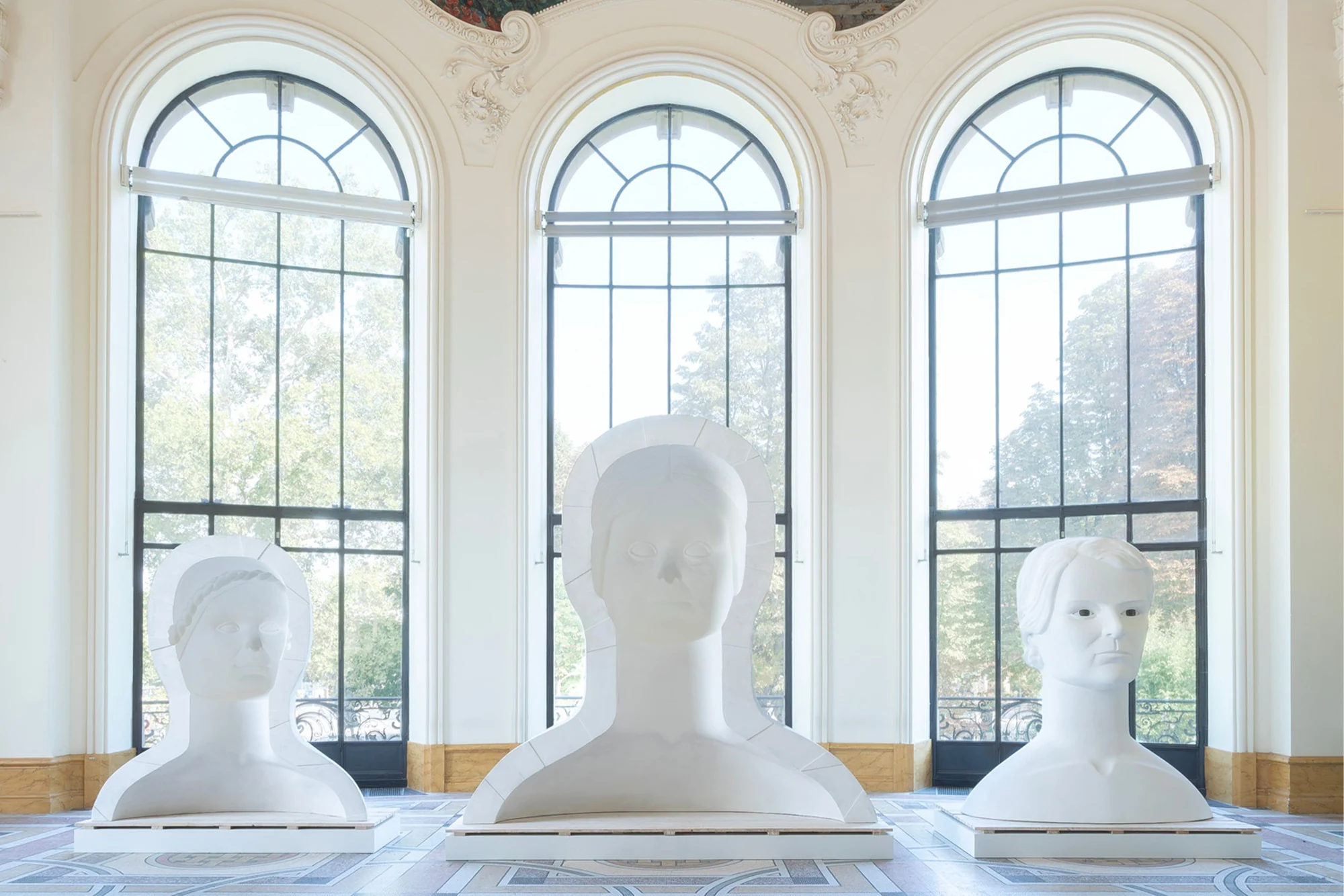
Eighteen women sculptors have acquired a new presence at the Petit Palais. Opened on October 20, 2026, Prune Nourry’s Visionnaires introduces portraits of artists whose work and identities have received uneven recognition. The exhibition continues through January 24, 2027, extending from the museum’s forecourt into its collections and garden. 1
Three art historians spent a year gathering writings and photographs that informed Nourry’s portraits. The subjects include Nancy Elizabeth Prophet, Käthe Kollwitz, Jane Poupelet and Sarah Bernhardt. Bringing these faces into a museum creates a useful double encounter: an artwork asks for attention, while its subject points toward another body of work to discover. 1
Plaster carries much of the intervention. The museum explains that approximately 70 percent of its sculptures are studio plasters, giving Nourry’s chosen material an existing context. Her new busts range from 70 centimetres to 3.5 metres high; marble eyes recur within the sculptures and on museum pedestals. Scale and the returning gaze become ways of directing attention through the collection. 1
One of the project’s strongest historical connections is Hélène Bertaux. Nourry’s account identifies Bertaux’s sculpture Psyché as a prominent presence in the exhibition and her activism as a particular inspiration. Bertaux founded the Union des Femmes Peintres et Sculpteurs in 1881 and campaigned for women’s admission to the École des Beaux-Arts, which remained closed to them until 1897. Her inclusion gives the exhibition a concrete institutional history: access to training helped determine who could become an artist in the first place. 2
Nourry has previously used groups of sculpted figures to examine how female lives are valued. For Terracotta Daughters, begun in 2012, she worked with craftspeople in China to produce 108 individual, life-size figures, drawing on the techniques of the ancient terracotta army and modelling the project on eight girls. The comparison helps locate Visionnaires within a sustained practice: repetition produces a collective presence while individual faces resist anonymity. 3
The portraits also change how the permanent collection can be read. An enlarged face interrupts the scale of neighbouring objects; a marble eye directs attention to a pedestal that might otherwise pass unnoticed. These interventions connect recognition to the experience of moving through a museum. A newly visible portrait can prompt the search for an artist’s own sculpture, giving the visitor a reason to follow that name beyond the exhibition.